

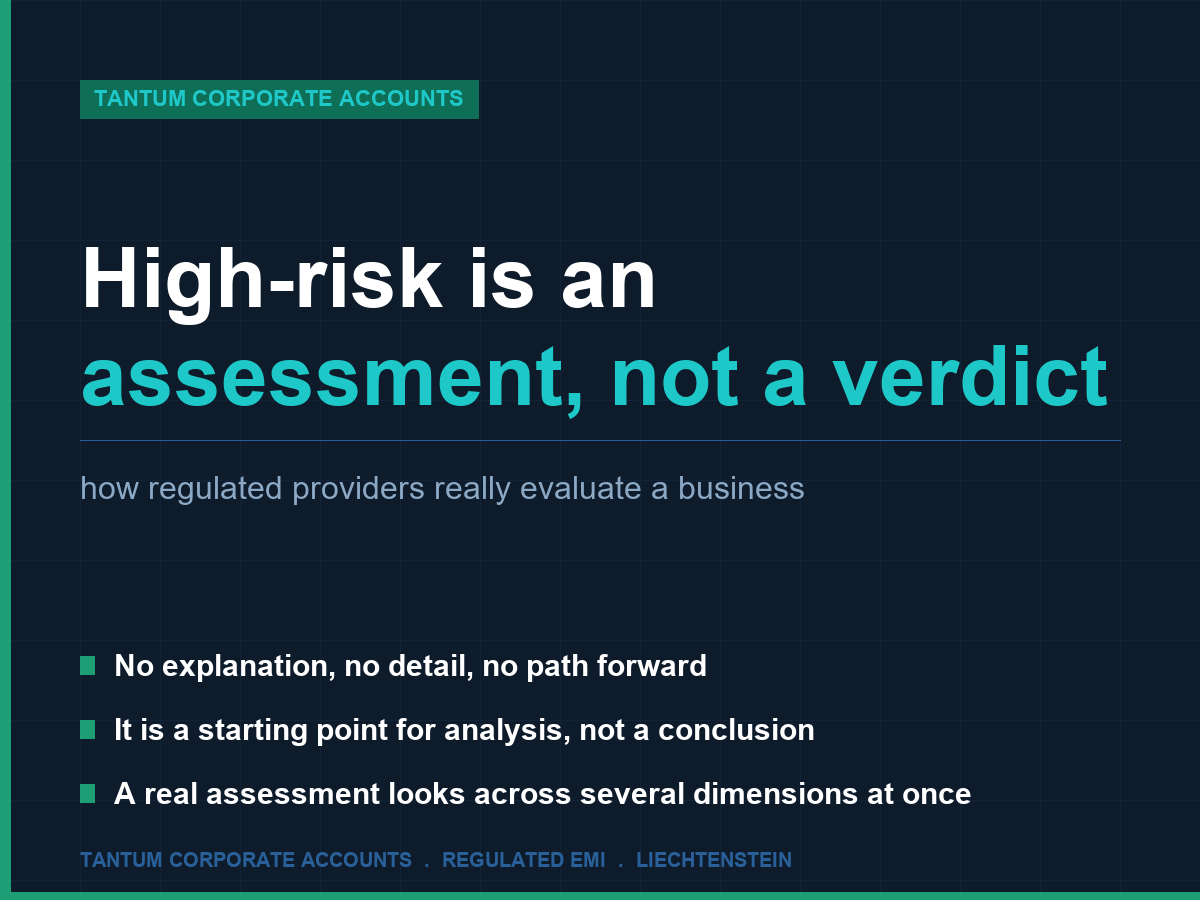
You apply for a corporate account. Weeks later, a terse email arrives: application declined. No detail, no path forward. If you operate in crypto, Web3, or affiliate marketing, this scene may feel familiar. The label 'high-risk' is applied widely and explained rarely—and that gap leads businesses to assume it is permanent. It is not. It is a starting point for analysis, not a conclusion.
What risk assessment actually examines

["When a regulated provider evaluates an application, they are not checking an industry category against a blocklist. A real assessment looks across several dimensions at once.\n\nSector sits at the beginning, not the end. Yes, crypto and affiliate businesses operate in areas regulators scrutinise more closely. But sector alone rarely determines an outcome. What follows matters far more.\n\nGeography shapes the picture significantly. Where do your customers, counterparties, and banking relationships sit? Certain jurisdictions carry additional compliance requirements under frameworks like MiCA, and a business with globally distributed flows will be looked at differently to one with concentrated, well-documented regional activity.\n\nTransaction flows tell a story. The volume, frequency, and predictability of payments—and how well they match the business model you describe—are central to how compliance teams think. Unexplained variation is a question mark. Explainable variation is a conversation.\n\nCounterparties carry weight. Who you pay and who pays you matters. Well-documented relationships with known entities read very differently from undocumented or opaque ones. Controls demonstrate maturity: does your business have its own AML procedures? Do you understand your own customer base? Businesses that have thought carefully about their own risk environment are more straightforward to assess.
Why different providers reach different answers

Different institutions have different appetites, different capabilities, and different team expertise. A provider with no experience in Web3 compliance will often decline not because the business is ungovernable, but because they lack the framework to assess it confidently. A provider with genuine sector knowledge—such as those regulated by authorities like the FMA Liechtenstein—can engage with complexity that others default to rejecting.\n\nThis is worth understanding because it changes how you approach the process. Being declined is data, not a definition. It tells you something about that provider's capacity, not necessarily your business's fundability.\n\nTantum is a Liechtenstein-regulated EMI built to provide multi-currency corporate accounts, dedicated IBANs (EUR, USD, GBP, CHF), and mass-payout infrastructure for businesses with real operational complexity. We assess applications on their actual merits, with sector knowledge that allows us to engage seriously with crypto, Web3, affiliate operators, and complex structures.
How to present your business accurately

The most effective thing a business can do is close the information gap that compliance teams are trying to fill. This means:\n\n- Articulate your business model clearly and briefly\n- Document major customer and counterparty relationships upfront\n- Explain your transaction patterns before being asked\n- Show that you have thought about your own compliance obligations—not just your provider's\n\nBusinesses that approach onboarding with prepared, honest documentation have a different experience from those who rely on the provider to draw their own conclusions from incomplete information.\n\nPreparing this material is not about ticking boxes. It is about demonstrating that you understand the environment you operate in—and that you have structured your business to manage it responsibly. That clarity changes the conversation.
If you have been declined elsewhere and want to understand whether we can help, the right starting point is a direct conversation. Reach our team at tantumpay.com/kontakt to discuss your specific situation.
Tags: #high-risk business#compliance#corporate accounts#fintech#crypto payments#web3